
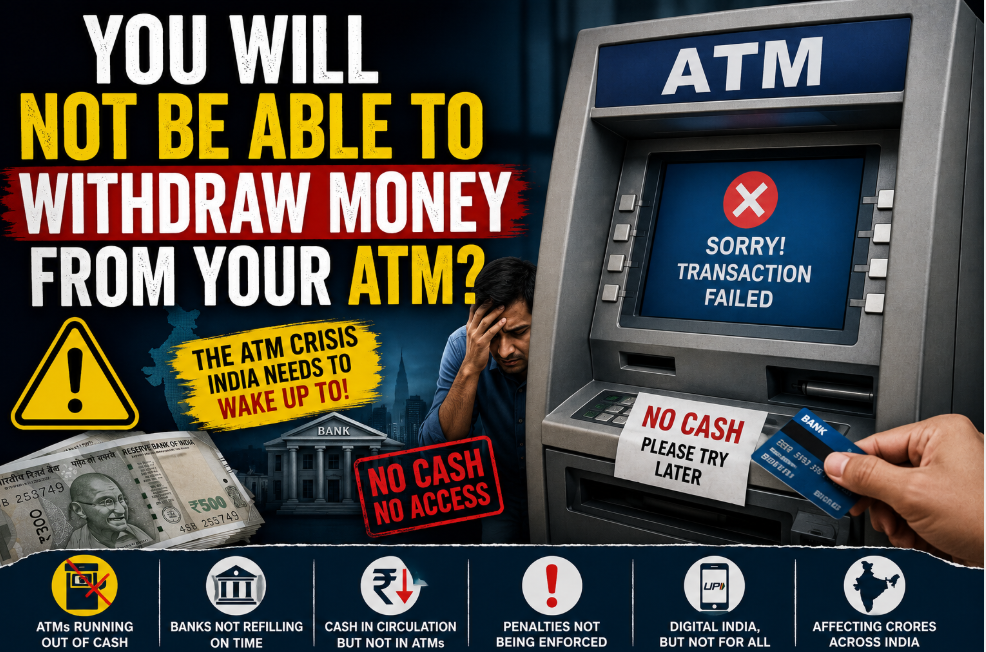
For years, India has been moving toward a digital economy. First came demonetization, then the government’s push for a cashless society, and finally the explosive growth of UPI payments. Today, many people use their phones to pay for everything from groceries to a cup of tea. Because of this, most of us assume that cash is slowly disappearing from everyday life.
However, a recent dispute involving the Confederation of ATM Industry (CATMI), the Reserve Bank of India (RBI), and the State Bank of India (SBI) has raised an important question: If digital payments are growing so rapidly, why are ATMs across many parts of the country reportedly running out of cash?
The controversy began when CATMI, the organization representing India’s ATM industry, raised concerns with the RBI. According to reports, the organization claimed that ATM operators are facing significant financial losses and that the situation has become serious enough to threaten the smooth operation of ATM services. CATMI has reportedly sought compensation of around ₹100 crore and has accused SBI, which operates the country’s largest ATM network, of not maintaining adequate cash availability in many machines.
What makes the issue more surprising is that it comes at a time when digital payments have become a global success story for India. UPI transactions have reached record levels, and many people rarely carry cash anymore. From street vendors to shopping malls, QR code payments have become a normal part of daily life.
Yet the RBI’s own data tells a different story about cash usage. According to official figures, the amount of currency in circulation has increased dramatically over the last few years. In 2020, cash in circulation was around ₹24 lakh crore. Today, that figure has reportedly risen to nearly ₹43 lakh crore. This means that despite the rise of digital payments, physical cash remains an important part of India’s economy.
This creates an interesting contradiction. If more cash than ever is circulating in the economy, why do so many people report finding ATMs without cash?
One possible explanation is that the issue is not a shortage of currency but a problem with cash distribution and ATM management. Maintaining an ATM network is expensive. Machines need regular maintenance, security arrangements, electricity, internet connectivity, and frequent cash replenishment. If ATM operators are not receiving sufficient revenue from transactions, some may struggle to keep machines functioning efficiently.
The problem is particularly important for smaller cities and rural areas. While residents of major metropolitan cities may have multiple digital payment options, millions of people in smaller towns and villages still depend heavily on cash. Internet connectivity is not always reliable, and many local transactions continue to be conducted using physical currency. For these communities, a cashless ATM is more than an inconvenience it can disrupt everyday financial activities.
The RBI had introduced rules aimed at preventing such situations. Under these guidelines, banks can face penalties if ATMs remain out of cash for extended periods. However, critics argue that enforcement has not been strict enough to ensure consistent cash availability across the country.
Following CATMI’s complaint, the Department of Financial Services reportedly asked SBI to provide an explanation and submit a report. Authorities want to understand why ATM cash shortages are being reported despite repeated assurances that there is no shortage of currency in the banking system.
The bigger question remains unanswered: where is the growing volume of cash actually going? If consumers are increasingly using digital payments, yet cash in circulation continues to rise, there may be economic factors at work that are not immediately visible to the public.
At the moment, there is no indication that ATMs will disappear anytime soon. Digital payments may be transforming India’s financial landscape, but cash remains essential for millions of people. The current debate highlights an important reality: even in the age of UPI, a country as large and diverse as India still needs a strong and reliable cash distribution network.https://unbiasedpollkhol.com/
The coming weeks may provide more clarity as banks, regulators, and ATM operators respond to the concerns raised by CATMI. Until then, the discussion serves as a reminder that India’s financial future is likely to be a combination of both digital convenience and traditional cash transactions.
For more such update, subscribe us so that you don’t miss any government job update
You can also email us @Unbaisedpollkhol@gmail.com