
A cyclone has recently formed in the Bay of Bengal, triggering alerts and concern across coastal regions. While the impact of such storms is serious, one thing often catches attention every time their names.
This recent cyclone is called “Motha”, and interestingly, the name was given not by India but by Thailand.
So the question naturally comes up:
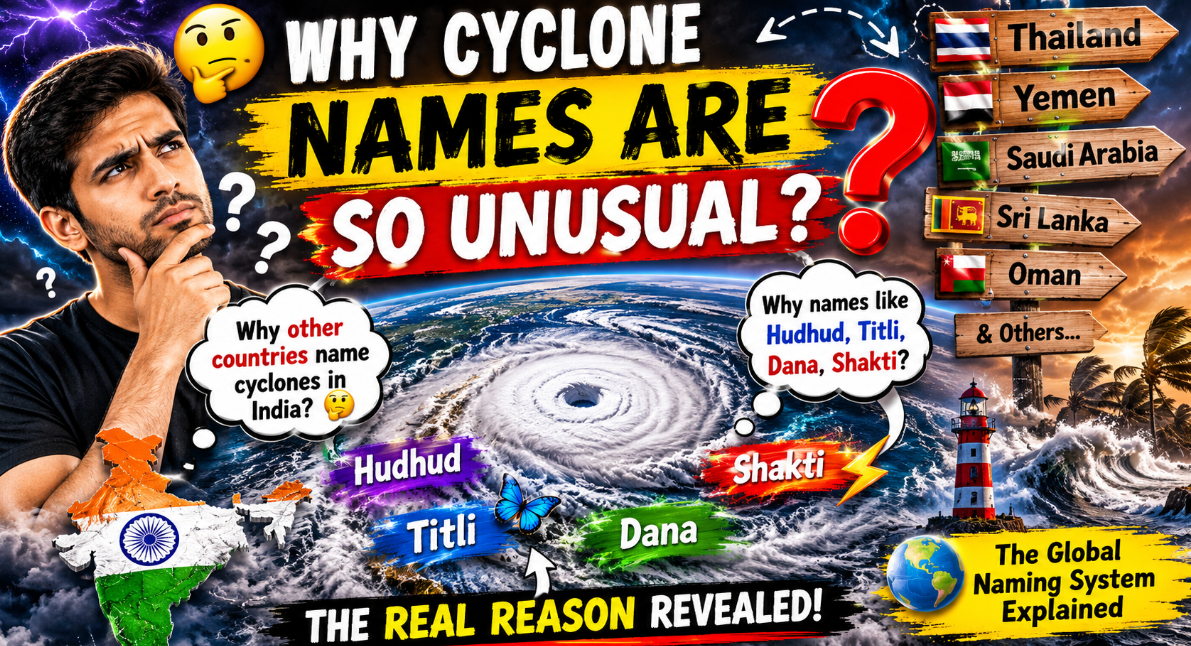
Why do cyclones have such names? And why are countries like Thailand, Yemen, or Saudi Arabia naming storms that affect India?
The answer lies in a fascinating global system designed for safety, communication, and scientific tracking. https://en.wikipedia.org/wiki/Tropical_cyclone_naming
Why Cyclones Are Given Names
Earlier, cyclones were identified using technical numbers or location-based descriptions like “cyclone 3 of 1998.” This created confusion, especially when multiple storms existed at the same time.
To solve this problem, meteorologists introduced a simple idea: give each cyclone a unique name.
This made communication easier for governments, media, and the public. Instead of complicated codes, people could easily remember names like Hudhud, Titli, Gulab, Dana, or Motha.
Even though cyclones are destructive, their names are intentionally simple so that warnings can be clearly understood and quickly shared.
How the Cyclone Naming System Began
The practice of naming cyclones officially started in 1953 in the Atlantic Ocean region. At that time, meteorologists working under the World Meteorological Organization (WMO) and the National Hurricane Center in Miami (USA) introduced the system.
The goal was simple: improve tracking and forecasting of storms. When a cyclone has a name, it becomes easier to study its behavior, compare it with past storms, and issue public warnings in time.
Over time, this system was adopted globally, including the Indian Ocean region.
Why Cyclones in the Indian Ocean Region
For the North Indian Ocean region, which includes the Arabian Sea and the Bay of Bengal, cyclone naming is managed by the India Meteorological Department (IMD).
However, IMD does not work alone. It functions under the guidance of:
- World Meteorological Organization (WMO)
- ESCAP (UN Economic and Social Commission for Asia and the Pacific)
This region is important because cyclones here affect multiple countries, not just India.
Countries like India, Bangladesh, Sri Lanka, Myanmar, Oman, Pakistan, Thailand, and others all share coastal vulnerability to cyclones.
Why Other Countries Name Cyclones Affecting India
This is where it gets interesting.
There are 13 countries involved in the cyclone naming system for the North Indian Ocean region. These include India, Bangladesh, Iran, Maldives, Myanmar, Oman, Pakistan, Qatar, Saudi Arabia, Sri Lanka, Thailand, United Arab Emirates, and Yemen.
Each of these countries contributes equally to the naming process.
Instead of one country deciding all names, every country submits a list of suggested names. These names are collected and approved collectively by the group.
So when a cyclone forms in the Bay of Bengal or Arabian Sea, its name may come from any of these countries based on its position in the naming sequence.
That is why a cyclone affecting India can be named by Thailand or Yemen because it is part of a shared international system.
How Cyclone Names Are Selected
Each of the 13 countries submits a set of 13 names. This creates a combined master list of around 169 names.
When a cyclone forms, names are chosen in order from this list. The sequence follows the alphabetical order of the member countries.
So the rotation begins with Bangladesh, then India, Iran, Maldives, Myanmar, Oman, Pakistan, Qatar, Saudi Arabia, Sri Lanka, Thailand, UAE, and finally Yemen.
After Yemen, the cycle returns to Bangladesh again.
This ensures that every country gets equal participation over time.
When India Joined the System
While cyclone naming began globally in 1953, the system for the North Indian Ocean started in 2004.
The first named cyclone in this region was Onil, contributed by Bangladesh.
Since then, many named storms have occurred under this system, including recent ones like Fengal, Dana, Asna, Shakti, Remal, and now Motha.
Each name reflects the country whose turn comes in the alphabetical sequence.
Rules Behind Cyclone Names
The naming process follows strict international guidelines.
Names must be simple, short (usually under 8 letters), and easy to pronounce across different languages. They should not be offensive or linked to religion, politics, gender, or culture.
This is why cyclone names often sound unusual or even gentle, like flowers or everyday words.
For example, names like Gulab (rose), Titli (butterfly), or Motha (fragrant flower) may sound soft, even though the storms themselves are extremely powerful.
The purpose is not to describe the cyclone’s strength but to make it easy to identify and communicate.
Recent Cyclones and Their Naming Countries
Recent storms show how the rotation system works in real life.
Cyclone Shakti was named by Sri Lanka, while Motha was named by Thailand. Earlier cyclones like Fengal came from Saudi Arabia, Dana from Qatar, Asna from Pakistan, and Remal from Oman.
Each name reflects the next country in the alphabetical cycle, not the country where the cyclone occurs.
For more such update, subscribe us so that you don’t miss any government job update
You can also email us @Unbaisedpollkhol@gmail.com