

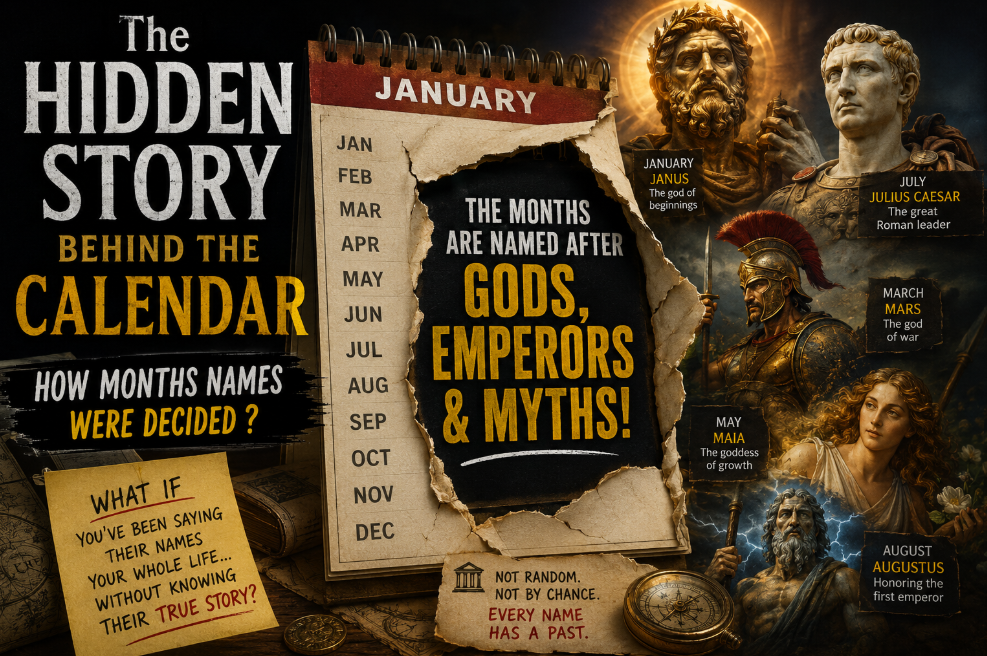
Have you ever wondered why the months are called January, February, March, April, and so on?
Or why January comes first and December comes last?
At first glance, these names may seem ordinary, but behind them lies a fascinating story connected to ancient Rome, mythology, war, nature, and even politics.
Surprisingly, there was a time when March was the first month of the year and February was the last. Even more shocking the earliest Roman calendar had only 10 months!
Let’s uncover the incredible history behind the modern calendar and the meanings of all twelve months.
The First Calendar Had Only 10 Months
The story begins in ancient Rome.
According to history, the first ruler of Rome, Romulus, created the earliest Roman calendar around 763 BC.
But this calendar was very different from the one we use today.
- It had only 10 months
- The year started with March
- The year ended with December
Why?
Because the calendar was mainly designed for military campaigns. During winter, Roman armies usually stayed home and did not fight wars. When spring arrived in March, soldiers would march into battle again. That is why March became the first month.
The cold winter period between December and March was not even counted properly in the calendar.
When January and February Were Added
Later, Rome’s second king, Numa Pompilius, added two more months to the calendar.
These two months eventually became:
- January
- February
However, even after adding them, the year still began with March.
That means February was once the last month of the year. Only centuries later did January officially become the first month.
The Meaning Behind Every Month
Now comes the most interesting part the origin of the month names themselves.
January – The Month of New Beginnings
January is named after the Roman god Janus.
Janus was shown with two faces:
- One looking into the past
- One looking toward the future
Because January marks the transition between the old year and the new year, the month was dedicated to this god of beginnings and change.
The old Anglo-Saxon people called it “Janueris Monath,” where “Monath” later became the English word “month.”
February – The Month of Purification
February comes from the Roman god Februus.
Ancient Romans celebrated purification rituals during this time to cleanse themselves from sins and mistakes of the previous year.
The word evolved from “Februus Monath” into the modern “February.”
This is why February was associated with purification and renewal.
March – The Month of War
March is named after Mars, the Roman god of war.
This was the season when Roman soldiers prepared for military campaigns after winter ended.
Originally, March was considered the first month of the Roman calendar, which explains why it held such importance. Interestingly, the planet Mars is also named after this god.
April – The Month of Beauty and Blossoms
The origin of April is debated by historians.
Some believe it comes from a goddess connected to beauty and spring, possibly Venus.
Others connect it to spring festivals and rebirth traditions.
April represents the season when flowers bloom, trees regain leaves, and nature becomes beautiful again.
This is also the time when Christians celebrate Easter in many years.
May – The Month of Growth
May is named after the Roman goddess Maia.
She was associated with:
- Fertility
- Growth
- Spring
- Nature
By this time of year, nature is fully alive, flowers are blooming everywhere, and the weather becomes pleasant.
June – The Month of Marriage
June is named after Juno.
Juno was considered the goddess of:
- Marriage
- Women
- Childbirth
- Family
Because of this connection, June became associated with weddings a tradition that still continues in many cultures today.
The Months Named After Numbers
After June, something interesting happens.
The month names stop being based on gods and begin using Latin numbers.
July – Named After Julius Caesar
Originally, July was called “Quintilis,” meaning “fifth month” in Latin.
Later, it was renamed in honor of Julius Caesar after his death.
“Julius” eventually became “July.”
August – Named After Augustus Caesar
August was originally called “Sextilis,” meaning “sixth month.”
It was later renamed after Augustus, the adopted heir of Julius Caesar.
Over time, “Augustus” became “August.”
Why September, October, November, and December Don’t Match Their Numbers
Here is the most confusing but fascinating part.
These month names still contain their original Latin numerical meanings:
- Septem = Seven → September
- Octo = Eight → October
- Novem = Nine → November
- Decem = Ten → December
But today:
- September is the 9th month
- October is the 10th
- November is the 11th
- December is the 12th
Why the mismatch?
Because in the original Roman calendar, March was the first month. When January and February were later shifted to the beginning of the year, all the later months moved two places forward but their names stayed the same.
That’s why December literally means “tenth month,” even though it is now the twelfth.
The Calendar We Use Today
Over time, the Roman calendar evolved into the modern system we follow today.
By around 525 AD, the structure of the year became more standardized, and January officially became the first month of the year.
Since then, the January-to-December calendar has remained largely unchanged across much of the world