
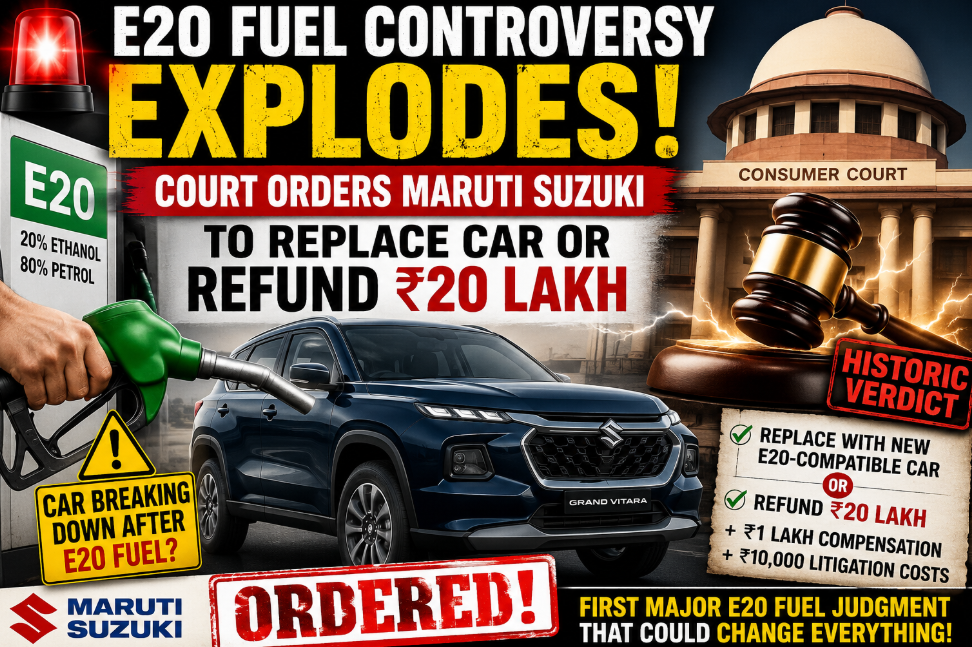
India’s transition to E20 ethanol blended fuel has sparked widespread debate among vehicle owners, with many claiming that their cars have developed mechanical issues after switching to the new fuel. Amid these concerns, a landmark consumer court judgment has brought the issue into the national spotlight. In what is being described as the first major legal ruling involving ethanol fuel compatibility, the Consumer Commission ruled in favour of a car owner and directed Maruti Suzuki to either provide a brand new replacement vehicle or refund the entire purchase price. The case is significant because it could set an important precedent for future disputes involving E20 fuel and automobile manufacturers, potentially leading to more consumers seeking legal remedies if they face similar problems.https://www.ndtv.com/auto/maruti-suzuki-to-challenge-e20-ruling-blames-fuel-contamination-in-grand-vitara-case-11783027
Mechanical problems running on E20 petrol
The case revolves around Dr. Premraj Devta, a resident of Raipur, Chhattisgarh, who purchased a Maruti Suzuki Grand Vitara Strong Hybrid Zeta+ in June 2024 for approximately ₹20 lakh. According to the customer, the vehicle began experiencing serious mechanical problems shortly after purchase while running on ethanol petrol, which had become widely available across India as part of the government’s ethanol blending program. The engine warning light repeatedly illuminated, the vehicle frequently lost power, the engine shut down unexpectedly while driving, and the overall performance deteriorated. Despite several visits to the authorized service center for repairs, the issues persisted. Frustrated by the repeated failures and the inability of the dealer to resolve the defects, Dr. Devta approached the District Consumer Disputes Redressal Commission, arguing that he had simply used the fuel officially available at petrol stations and therefore should not be held responsible for the vehicle’s failure.
Early launches causing customer’s pocket
India’s Ethanol Blending Programme, launched in 2003, initially introduced E5 fuel before gradually moving to E10 and eventually ethanol, which contains 20% ethanol and 80% petrol. Although the government had originally planned to implement E20 nationwide closer to 2028 to 2030, the rollout was accelerated significantly. According to the government, increasing ethanol blending helps reduce India’s dependence on imported crude oil, lowers vehicle emissions, strengthens energy security, and provides additional income opportunities for farmers by creating demand for agricultural feedstock used in ethanol production. Since ethanol is now the standard fuel available at most fuel stations, consumers generally have no practical alternative unless they purchase premium petrol grades, making fuel compatibility a critical issue for modern vehicles. One of the most important findings during the proceedings was that although the customer bought the vehicle in June 2024, it had actually been manufactured 17 months earlier in January 2023 before being sold as a new car. Maruti Suzuki and the authorized dealer denied any manufacturing defect and instead argued that the damage was caused by contaminated or adulterated fuel, claiming such damage falls outside warranty coverage. However, the customer strongly rejected this argument, maintaining that he had filled the vehicle with the officially available ethanol petrol sold at fuel stations. Laboratory examination reportedly detected ethanol related deposits within the fuel system, strengthening the customer’s argument that the manufacturer could not shift responsibility onto consumers when no alternative fuel option existed in the market.
Consumer Commission remarkable decision
After reviewing the evidence, the Consumer Commission made several significant observations. It concluded that consumers had no practical alternative to using ethanol petrol because it is the fuel officially supplied at petrol pumps across the country. Therefore, any vehicle sold in India should be fully compatible with the fuel available in the market. The Commission further observed that if a vehicle cannot safely operate on government approved fuel, the manufacturer must bear responsibility for ensuring compatibility. It also held that there had been a deficiency in service and an unfair trade practice under the Consumer Protection Act, 2019, since the customer continued to face repeated mechanical failures despite multiple repair attempts. As part of its final order, the Consumer Commission directed Maruti Suzuki and its authorized dealer to either replace the defective vehicle with a new E20 compatible Grand Vitara or refund the customer’s entire purchase amount of approximately ₹20 lakh. In addition, the Commission awarded ₹1 lakh as compensation for the mental harassment suffered by the customer and ₹10,000 towards litigation expenses. The Commission also warned that failure to comply with its order could result in additional legal consequences. The ruling has attracted nationwide attention because it is one of the first judicial decisions to directly address consumer rights in relation to E20 fuel compatibility and manufacturer responsibility.https://unbiasedpollkhol.com/
Maruti Suzuki, however, continues to maintain that there was no manufacturing defect in the vehicle and insists that the damage resulted solely from contaminated fuel rather than the use of E20 petrol itself. The company argues that similar vehicles have been operating without issues and may choose to challenge the Commission’s order before a higher court, meaning the legal battle is not necessarily over. Meanwhile, the Government of India continues to support E20 fuel, with Union Minister Nitin Gadkari repeatedly stating that modern vehicles are designed to safely operate on E20 and dismissing claims that the fuel itself damages cars. Nevertheless, even the government acknowledges that older vehicles Maruti Suzuki, however, continues to maintain that there was no manufacturing defect in the vehicle and insists that the damage resulted solely from contaminated fuel rather than the use of E20 petrol itself. The company argues that similar vehicles have been operating without issues and may choose to challenge the Commission’s order before a higher court, meaning the legal battle is not necessarily over. Meanwhile, the Government of India continues to support E20 fuel, with Union Minister Nitin Gadkari repeatedly stating that modern vehicles are designed to safely operate on E20 and dismissing claims that the fuel itself damages cars. Nevertheless, even the government acknowledges that older vehicles not specifically designed for E20 may experience challenges such as reduced fuel efficiency, corrosion in incompatible fuel systems, higher maintenance costs, and other operational issues. Regardless of the outcome of any future appeal, this judgment has significantly intensified the national conversation surrounding E20 fuel, consumer protection, and the responsibility of automobile manufacturers to ensure that vehicles sold in India are fully compatible with the country’s evolving fuel standards.