
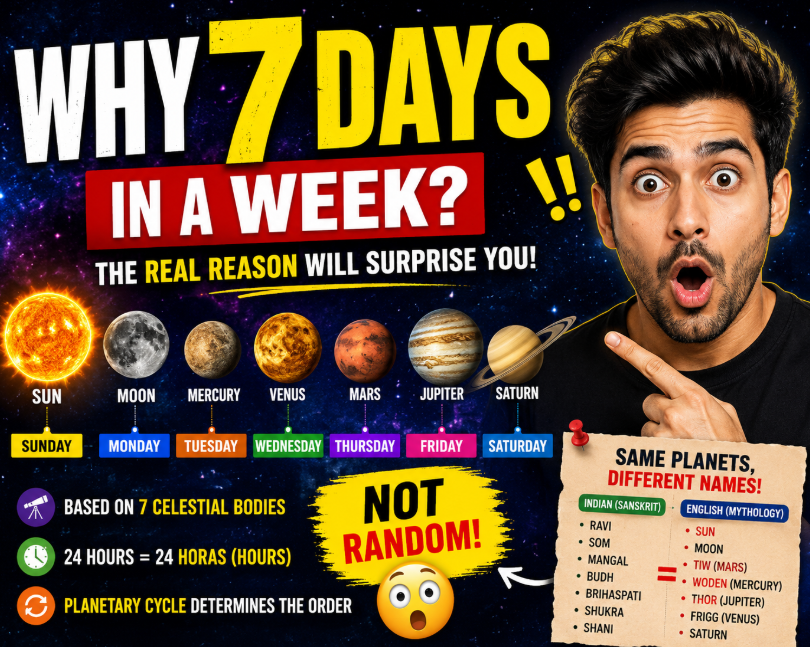
Have you ever wondered why a week has exactly seven days? And not just that why are they called Sunday, Monday, Tuesday, and why do they follow this exact order?
At first glance, it might seem random. But once you understand the logic behind it, it feels like a perfectly designed cosmic system. https://en.wikipedia.org/wiki/Week
The Origin of 7 Days
The concept of a seven-day week comes from ancient astronomy.
Long before modern science, people observed the sky and noticed seven important celestial bodies that were clearly visible from Earth:
- Sun
- Moon
- Mercury
- Venus
- Mars
- Jupiter
- Saturn
These were not just random objects they were believed to influence life on Earth. So ancient civilizations based their time system on these seven bodies.
That’s why a week has 7 days.https://www.timeanddate.com/calendar/days/7-days-week.html
The Concept of “Hora” (Hour)
Now comes an interesting concept Hora, which means hour.
Ancient time calculation divided a full day and night (24 hours) into 24 horas.
Each hour was ruled by one of the seven celestial bodies. These planets took turns influencing each hour in a fixed sequence, that is why
Planetary Order (Based on Speed)
The planets were arranged based on their speed (from slowest to fastest):
- Saturn
- Jupiter
- Mars
- Sun
- Venus
- Mercury
- Moon
This order kept repeating every hour.
How the Days Are Ordered
Here’s where it gets really interesting.
Let’s say the first hour of a day is ruled by Saturn. As each hour passes, the next planet in sequence takes over.
After completing 24 hours, the 25th hour determines the next day.
Because of how this cycle works mathematically, the next day doesn’t start with Jupiter it jumps to a different planet.
This creates the fixed weekly order:
- Saturday (Saturn)
- Sunday (Sun)
- Monday (Moon)
- Tuesday (Mars)
- Wednesday (Mercury)
- Thursday (Jupiter)
- Friday (Venus)
So the sequence is not random at all it’s based on a repeating astronomical cycle.
Where Did the Names Come From?
In India, days are named after planets using Sanskrit:
- Ravi → Sunday
- Som → Monday
- Mangal → Tuesday
- Budh → Wednesday
- Brihaspati → Thursday
- Shukra → Friday
- Shani → Saturday
In English, however, the names come from Roman and Norse mythology:
- Sunday → Sun
- Monday → Moon
- Tuesday → Tiw (Mars)
- Wednesday → Woden (Mercury)
- Thursday → Thor (Jupiter)
- Friday → Frigg (Venus)
- Saturday → Saturn
So even though the names are different, the underlying planets are the same.
What looks like a simple weekly calendar is actually based on:
- Astronomy
- Planetary motion
- Ancient mathematical cycles
So next time you say “Monday blues” or “Finally Friday,” remember you’re following a system designed thousands of years ago, guided by the stars.
Pretty cool, right?