
Introduction: How Israel Overcame Water Scarcity
Water scarcity is one of the biggest global challenges today, but Israel has achieved something remarkable. Despite being largely desert, the country has not only solved its water crisis but also produces surplus water.
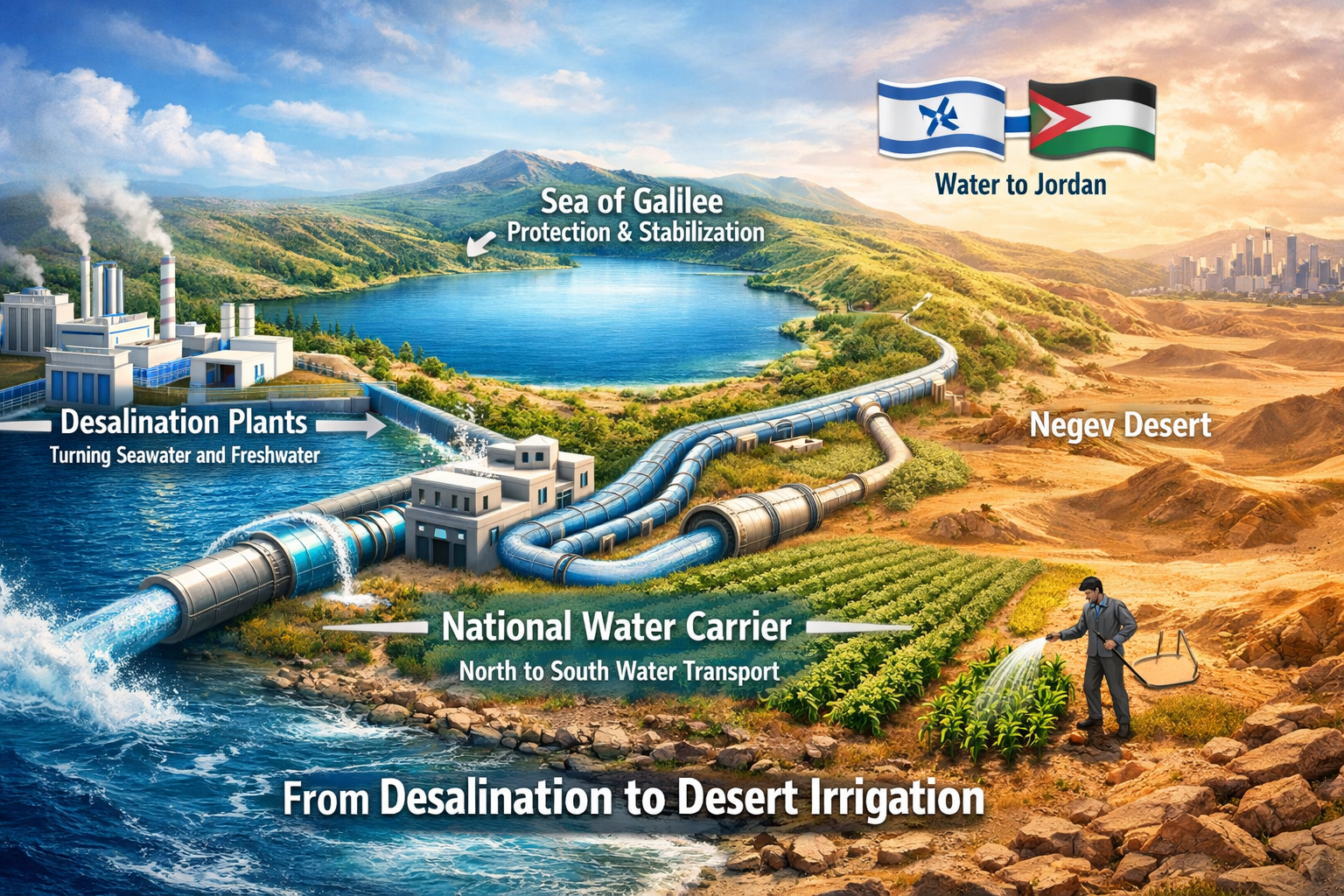
One of the most innovative steps includes refilling the Sea of Galilee using desalinated seawater from the Mediterranean. This breakthrough has made Israel a global leader in water management. https://unbiasedpollkhol.com/
Historical Background: The Roots of the Crisis
By the 1950s, Israel was facing severe water shortages. Rapid population growth and agricultural expansion increased pressure on limited freshwater resources.
The idea of diverting water from the Jordan River to arid regions was first proposed in 1937 by Walter Clay Lowdermilk. Although delayed by global conflicts, this vision later shaped Israel’s water strategy.
The Game Changer: National Water Carrier
After independence, Israel launched a mega infrastructure project the National Water Carrier. https://www.irishtimes.com/news/ireland/irish-news/how-israel-used-desalination-to-address-its-water-shortage-1.3959532
Completed in 1964, this 130-kilometer system transports water from the Sea of Galilee to the Negev Desert. Built by Mekorot, it includes pipelines, tunnels, reservoirs, and pumping stations.
- Transformed desert into agricultural land
- Supplied nearly 50% of drinking water by the 1990s
- Supported economic growth
Between 2012–2017, Israel faced a severe drought. Water levels in the Sea of Galilee dropped to historic lows, highlighting the risks of relying on natural freshwater sources.
This pushed Israel to accelerate alternative water solutions.
Israel invested heavily in desalination along the Mediterranean coast using advanced reverse osmosis technology.
The Ashkelon Desalination Plant, once the largest in the world, marked a turning point.
Today:
- Israel produces 600 million cubic meters of desalinated water annually
- Around 80% of domestic drinking water comes from desalination
- In 2022, Israel launched a groundbreaking project pumping desalinated water back into the Sea of Galilee.
- This system, built by Mekorot, uses underground pipelines to maintain lake levels during droughts.
- Stabilizes freshwater reserves
- Prevents ecological damage
- Ensures long-term water security
Israel leads the world in wastewater recycling, treating over 90% of its sewage.
The Shafdan Wastewater Treatment Plant plays a major role by recycling water for agriculture, especially in desert regions.
Another Israeli innovation is drip irrigation, pioneered by Netafim.
This system:
- Delivers water directly to plant roots
- Reduces evaporation loss
- Achieves up to 95% water efficiency
- Under the 1994 peace agreement, Israel supplies water to Jordan, making the Sea of Galilee a shared resource.
- Water supply has increased over time, strengthening regional cooperation.
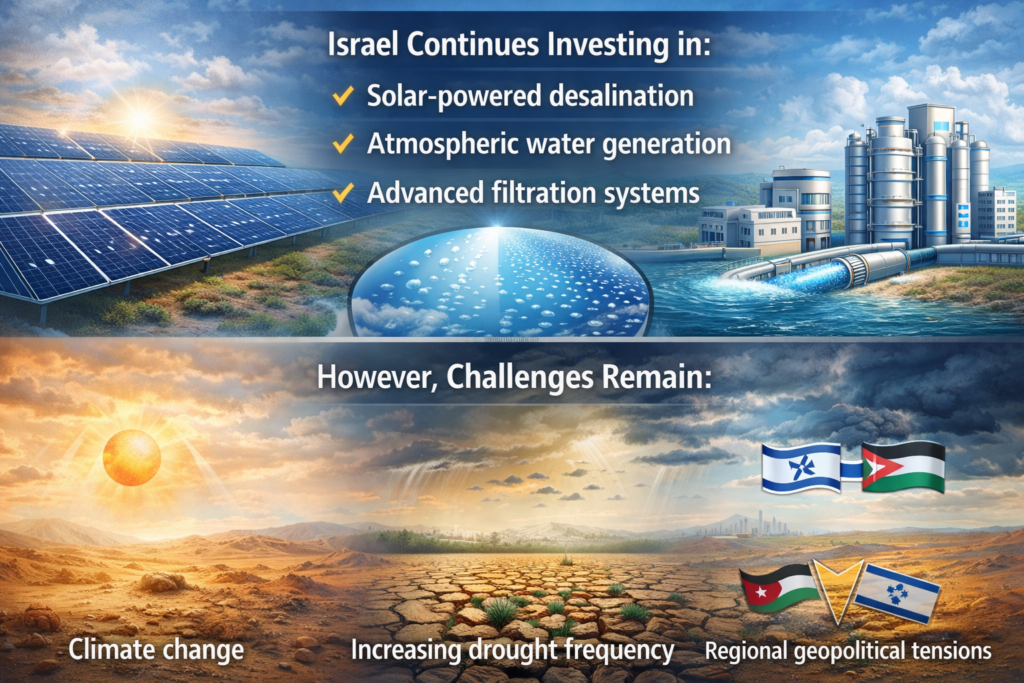
Israel continues to push the boundaries of water innovation with a forward-looking approach that blends technology and sustainability. The country is actively investing in solar powered desalination systems, aiming to reduce energy costs and environmental impact while producing freshwater from the Mediterranean Sea. At the same time, emerging technologies like atmospheric water generation are being explored, which extract moisture directly from the air, offering a potential solution for regions with limited water sources. In addition, advanced filtration and recycling systems are being continuously upgraded to ensure that wastewater can be efficiently treated and reused, particularly in agriculture, where Israel already leads globally in water recycling.
Conclusion: Lessons for the World
Israel’s water journey feels less like a single breakthrough and more like a carefully engineered symphony, where every drop is planned, moved, and reused with precision. From transforming seawater of the Mediterranean Sea into drinking water, to optimizing distribution through national infrastructure and reusing wastewater at an unmatched scale, the country has turned a natural limitation into a technological advantage. What once looked like a harsh constraint has been reshaped into a model of resilience and innovation.
Yet, this story doesn’t end with success alone. The growing pressures of climate change, unpredictable rainfall, and regional complexities mean that the system must constantly evolve. Water security here is not a fixed achievement but an ongoing process, requiring continuous investment, adaptation, and strategic thinking. Israel’s approach shows that solving a crisis is not about finding a single answer, but about building a flexible system that can respond to future uncertainties.
Ultimately, the lesson extends far beyond one nation. In a world where water scarcity is becoming a shared global challenge, Israel’s experience offers a powerful reminder that with the right mix of technology, policy, and long-term vision, even the driest landscapes can be made to flow with possibility.